It’s time for another installment of Queer Superhero History, where we look back at queer characters in mainstream superhero comics, in (roughly) chronological order, to see how the landscape of LGBTQ+ rep in the genre has changed over time. Today, we’re taking a look at a couple of DC supporting characters: Terry Berg and Holly Robinson!
Since at least the days of Arnie Roth, superhero comics have been sprinkled with queer civilian characters. (Arguably even before—someday I’ll write about Anton Previn, Barry Allen’s incredibly unsubtle Parisian fashion designer buddy who showed up in 1961, and who is an unmitigated delight.) Sometimes these characters were pushed far to the margins, like Kevin Mayer, Wonder Woman’s, uh, publicist’s brother, who first appeared as an explicitly gay character in 1988, in open defiance of the Comics Code, and thus was still groundbreaking despite his marginal role. Over the years, though, queer civilians became more frequent and more prominent.
I’ve mostly focused this series on superheroes (and the occasional supervillain), because, well, we’re talking about superhero comics. But there are a couple of civilian friends who, like Arnie Roth, are significant enough that I wanted to give them a closer look.
Terry Berg
Terry Berg first appeared in Green Lantern #129 (October 2000), and was created by Judd Winick and Darryl Banks. Green Lantern at the time was Kyle Rayner, a professional artist when not dealing with threats from outer space. In #129, he gets a cushy gig drawing a comic strip for trendy Feast magazine, which for some reason comes with a benefits package and an assistant? Well, a part-time paid intern in the form of 16-year-old, charmingly witty, inexplicably mulleted Terry Berg.
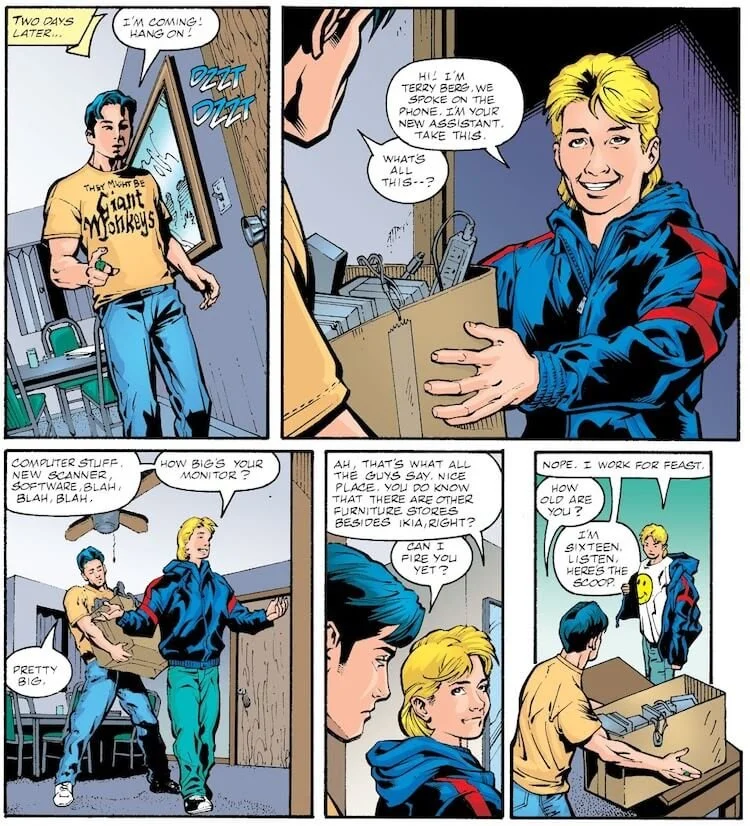
Terry’s first appearance. It’s amazing he could fit through the door with all that personality. [Green Lantern #129 (October 2000), art by Darryl Banks and Andy Smith.]
Terry quickly becomes a fixture in Kyle’s life…and increasingly sulky about Kyle’s relationship with his girlfriend. In #137 (June 2001), Kyle tells Terry that he (unsuccessfully) proposed…and Terry bursts into tears and runs out of the apartment. It’s only then that the penny drops for Kyle: Terry has a crush on him.
After some well-intentioned bumbling around, Kyle heads out to Terry’s parents’ house to talk to him. (Terry, somewhat implausibly for a 16-year-old in 2001, has a Bette Midler poster on his wall. As someone who was in high school in 2001, I assure you it should’ve been Lance Bass.) He then delivers a heartfelt, five page speech about how it’s okay to be gay, that there’s nothing wrong with Terry, and that he’s flattered—but also a straight adult with a girlfriend, so nothing is going to happen on that front. They end the issue by hugging it out.
To a modern reader, this scene might read as pretty cheesy. Kyle is running right through a playbook of encouraging talking points, like he read a pamphlet called “What To Do When Your Inexplicable Intern Comes Out To You.” The fact that it’s a whopping five pages (the entire comic is only 22) and that it’s mostly a straight guy monologing contribute to the overall feeling that you’re reading a PSA. Winick’s own biography is also relevant here; before he broke into superhero comics, he was a cast member on the third season of the MTV reality show The Real World, where he became close friends with openly gay castmate Pedro Zamora. Zamora died due to complications from AIDS later that year, and Winick went on to win a GLAAD award for his autobiographical comic, Pedro and Me, as well as pick up Zamora’s baton as an AIDS educator for a while. His early-to-mid-2000s comics have a tendency towards well-intentioned soapboxing; see also Green Arrow #25 (February 2005) where Mia Dearden (Speedy) talks about living with HIV.
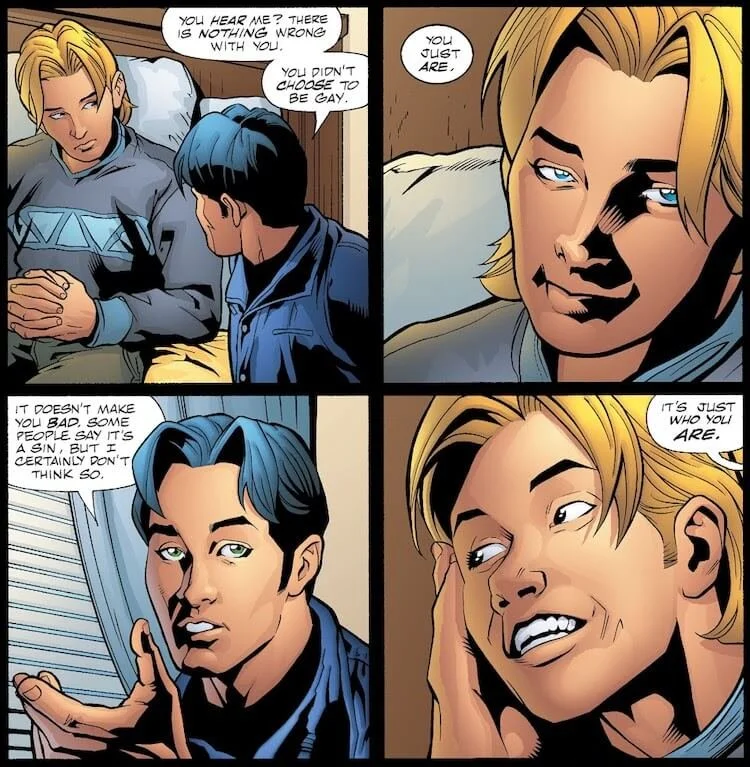
This is very sweet. It’s also five pages long. [Green Lantern #137 (June 2001), art by Darryl Banks and Rich Faber.]
But that’s to a modern reader. DC received so many letters in response to Green Lantern #137 that they printed responses in both #140 and #141. They maintained a strict “both sides” approach, printing two positive and two negative letters in each issue, which seems to me to sort of undermine Kyle’s whole speech: “Hey kids! It’s okay to be gay, but we’re going to publish four separate screeds against your existence in the interest of ‘fairness!’” is a bit of a mixed message. While the negative letters do accuse the comic of being preachy, they also describe it as supporting “sexual perversion” and indoctrination.
The positive letters, however, take zero issue with the execution of the story, calling it “the best ‘coming out’ story I have ever read in a comic book,” “handled incredibly well,” and “socially enlightened and helpful as well as a well-crafted tale.” Several of the positive letter writers say they wish they’d had a comic like this one when they were younger.
And I think it’s important to note that while superheroes had shown understated support for queer characters, as far as I can tell from my research, there had been nothing like Kyle’s declaration of uncompromising support and acceptance before this. Superman had vaguely felt that a lesbian shouldn’t lose custody of her kid; the Flash had a gay friend but couldn’t, like, talk about it; Superboy thought homophobia was uncool. The closest another comic had come to this kind of vocal, personal pro-gay rhetoric from a straight superhero was Captain America’s impassioned defense of a catatonic Arnie Roth. Maybe Kyle’s speech was overdue.
Things go downhill for Terry in #154 (November 2002), when he and his boyfriend David are attacked by gaybashers, who beat Terry so badly he ends up in a coma. It’s a major media story—in a darkly hilarious moment, then-president Actual Supervillain Lex Luthor gives a speech condemning the attack, which…someone please take me to live in the DC universe. I don’t care how often my city gets attacked by talking gorillas.
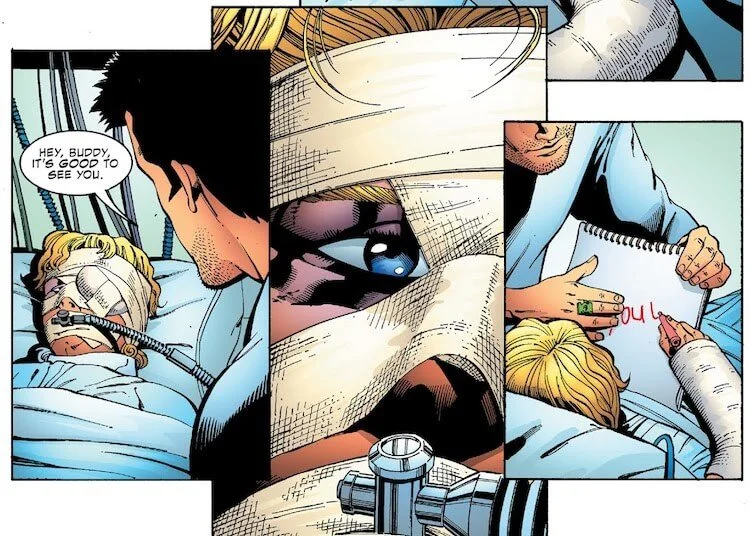
One of the less viscerally upsetting images of this storyline, after Terry wakes up. [Green Lantern #155 (December 2002), art by Dale Eaglesham and Rodney Ramos.]
While #137 feels dated but charming, #154 has not aged well at all, and I’m not just talking about inaccurately predicting how a felon would behave in the Oval Office. It relies extremely heavily on shock value: the cover is a closeup of Terry’s maimed, nigh-unrecognizable face as his head is dragged up by the hair by his assailants, and slurs are chucked around carelessly, including (sarcastically) by Kyle.
But the real problem is that the story isn’t actually about Terry. Terry is unconscious for almost two entire issues; his voice and agency are completely removed. Instead, we get two issues of Kyle stomping around brutalizing Terry’s attackers and generally throwing tantrums. Finally, Kyle decides that even though Terry has woken up from his coma, Kyle’s too angry at humanity to protect it, so he leaves Earth for an extended plotline in space. Terry’s trauma is ultimately a catalyst for Kyle’s relocation more than anything else.
Terry only appears sporadically after this, though there is some effort to tie up his plotline: he recovers from his injuries, begins working with the fictional Human Tolerance League, and becomes a media darling. His mother even apologizes (weirdly, to David and not to Terry) for being homophobic, though his father appears to be a lost cause. His last appearance is a brief fakeout where we’re meant to think he’s been given a Green Lantern ring, but it turns out Kyle just somehow projected himself back to Earth by manifesting as a ring on Terry’s finger. We don’t even get to see Terry and Kyle’s reunion, as it happens off-page, along with Terry disappearing from comics forever. He’s been MIA since 2004.
As you can probably tell, I’m not a huge fan of how the gaybashing storyline was handled, and I’m disappointed that Terry was phased out so unceremoniously. But again, it’s important to put these stories in contemporary context, and it’s worth noting that Green Lantern won the GLAAD Award for Best Comic in 2002 and 2003, which would have encompassed both Terry’s coming out and the gaybashing storyline.
Holly Robinson
Holly Robinson first appeared in Batman #404 (February 1987), more famously known as the first issue of Batman: Year One, and was created by Frank Miller and David Mazzucchelli. She is an underage sex worker—the art makes her look about ten, and yes, it’s supposed to be that disturbing—and a little sister figure to Selina Kyle, Catwoman. When a young, not-quite-Batman-yet Bruce Wayne gets into a fight with her pimp, Holly stabs him in the leg, which is both sad and kind of funny.
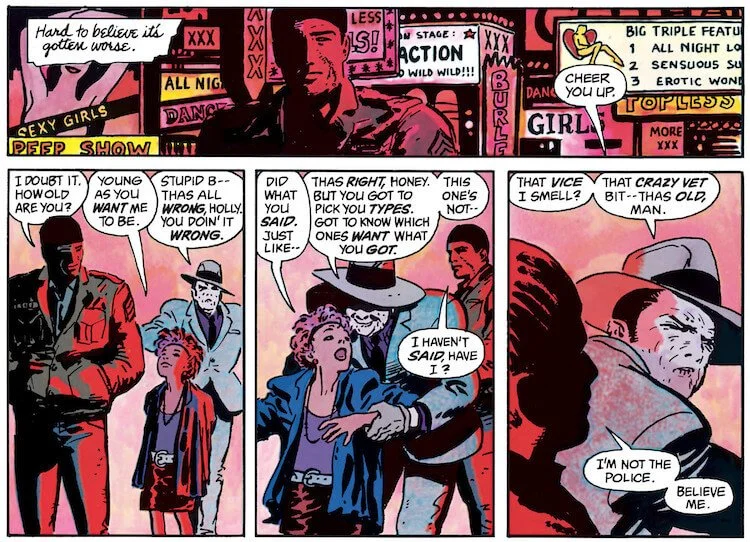
Holly’s first appearance. It’s…extremely Frank Miller. [Batman #404 (February 1987), art by David Mazzucchelli.]
Holly continued to appear sporadically in Catwoman stories after that, including one in which she dies. Luckily for Holly, Ed Brubaker hadn’t read the latter story when he started writing the 2002 Catwoman series, and so included a grown-up Holly in Catwoman #1 (January 2002), alive and well. Holly tells Selina about a killer targeting sex workers, and the two of them take the killer down, after which Selina hires Holly to be her eyes and ears on the street.
In Catwoman #6 (June 2002), we meet Holly’s girlfriend, Karon. She’s introduced without fanfare, with the narration describing her as “someone that [Holly] really love[s],” and at the end of the scene the two women part with a kiss—one of the first between two women in a main universe DC comic, if not the first, albeit a silhouetted one.
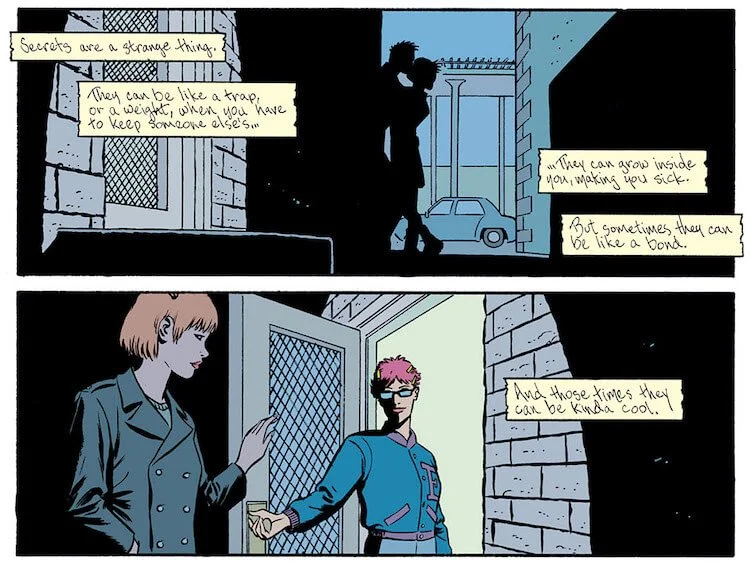
Possible the first kiss between women in a DC comic. Despite Holly’s narration about secrets here, neither she nor Karon do anything to hide their relationship or sexualities over the course of the series. [Catwoman #6 (June 2002), art by Bradley Rader and Cameron Stewart.]
Holly is a major player over the next five years, taking a central role in multiple arcs. In one storyline, she’s kidnapped by villains and ultimately kills one of them to save Selina’s life, leaving her severely traumatized; in the aftermath, Selina arranges for Holly to be trained by the superhero Wildcat. When Selina gets pregnant, she asks Holly to take over for her as Catwoman. However, Holly is ultimately unmasked on camera and falsely accused of murder, and has to abandon her real name and flee Gotham (and the Catwoman comic) in #69.
Throughout all of this, her relationship with Karon remains steady. Karon is shown supporting Holly through her trauma and acting as a minor but respected member of Team Catwoman. In #26 (February 2004) the two move in together and share their first unobscured kiss. Together they act as den mothers to the street kids of Gotham’s Alleytown. Unlike Green Lantern’s loud PSAs, their relationship is never the focus of the book, but it’s a quiet, consistent presence for half a decade that’s treated as entirely normal and unremarkable. The GLAAD Award committee seemed to like both approaches; Catwoman won Best Comic in 2004.
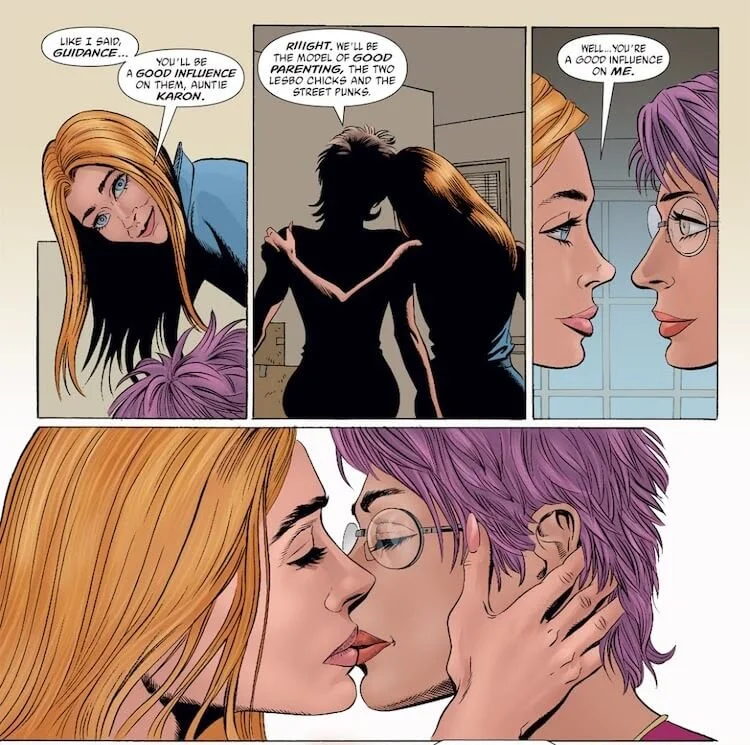
As we saw with Harley and Ivy, it often took a while for couples in the 2000s to get clearly drawn kisses, rather than ones in silhouette, like the kiss above, or where the positioning is ambiguous. This is Holly and Karon’s first, 20 issues into their relationship. [Catwoman #26 (February 2004), art by Paul Gulacy and Jimmy Palmiotti.]
Unfortunately but predictably, Karon disappeared from the book when Holly did and has not reappeared since. Holly had a major supporting role in the widely-reviled Countdown series, about which the less said, the better. A revamped version of her appeared in DC’s 2016 Rebirth reboot. And a more familiar Holly showed up just last month in Catwoman #87 (May 2026); hopefully we’ll get to see Karon again too, or at least a little more of Holly’s personal life.
There’s a case to be made for queer stories that center queerness as a plot point and theme; stories that cannot be read without confronting what those stories have to say about queer identity and queer rights. And there’s a case to be made for stories that present queerness as completely unremarkable. I think we need both (as well as every other type of queer story, because of course queerness, basically by definition, doesn’t fit neatly into two boxes!). Looking at the way audiences responded to these two very different stories nearly a quarter century ago, it seems like at least some readers of the Oughts agreed.
Of course, the GLAAD Awards aren’t the only metric by which to judge the queer community’s response to a story—in the early years, they frequently seemed to award based on a criteria of “there’s a gay person in this book,” admittedly because that was often all they had—but it’s interesting to see Green Lantern’s aggressive messaging and Catwoman’s understated inclusion receive the same accolade. It’s a good reminder that we always need more queer stories: more perspectives, more approaches, and especially more queer voices.
Also, DC, thanks for bringing back Holly; now bring Terry back, too. Kyle’s back on Earth and doing art again and everything!