Queer Superhero History: The Sapphic Queens of the Golden Age
It’s time for another installment of Queer Superhero History, where we look back at queer characters in mainstream superhero comics, in (roughly) chronological order, to see how the landscape of LGBTQ+ rep in the genre has changed over time. Today: Queen Duoro and Queen Mulano!
But first, a little housekeeping. With last month’s Starman article, I’ve finished reposting all of the QSH articles I originally wrote for Book Riot, which means we’ll be moving to a monthly schedule for these to give me a little more time to research. I’m also occasionally going to be dropping in the occasional throwback to heavily suggestive Golden or Silver Age characters.
And thus we’re kicking off a new year by going way, way back to 1939—specifically, to Action Comics #12, cover dated to May. This was one of Superman’s earliest appearances, but Action was an anthology title for decades, and so this issue also features: reporter Scoop Scanlon! Cleancut athlete Pep Morgan! Adventurer Tex Thomson! Cowboy hero Chuck Dawson! A truly unreadable installment about Marco Polo, for some reason! Plus, an assortment of prose stories, short gag strips, and “fun” facts, including a feature about stamp collecting that was, unbelievably, popular enough to be a recurring one.
Most importantly for our purposes, it also featured Zatara, the Master Magician. Current comics fans will be familiar with his daughter, Zatanna Zatara, the backwards-speaking magician who has been kicking about the DCU as a fan favorite since 1964. But her father, Giovanni “John” Zatara (though his first name wouldn’t be given for decades), has been around since Action Comics #1, the same as Superman.
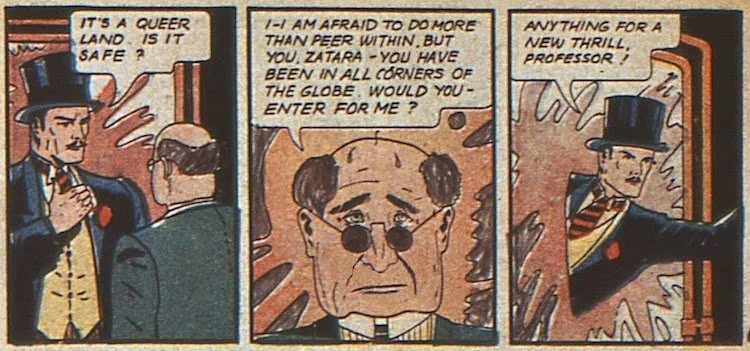
Presented: the first YOLO in comics. [All art from Action Comics #12 (May 1939), art by Fred Guardineer.]
In “The Land of the Fourth Dimension” by Gardner Fox and Fred Guardineer, Zatara is relaxing in the Explorers’ Club when he’s approached by a professor friend of his. The professor has invented a doorway into the fourth dimension and wants Zatara to try it out.
Given the way this story ends, I do feel obligated to share that as Zatara peers through the doorway, he declares: “It’s a queer land.” I don’t think this was foreshadowing, partially because the word was still widely used to mean “strange,” and though it had also been used to refer to homosexuality or sexual deviance since the late 19th century, I’m not sure it was commonly applied to women. But mostly I don’t think it was foreshadowing because I don’t think anyone working on a Golden Age comic was trying all that hard, except for maybe Will Eisner.
Anyway, Zatara steps through the doorway and finds himself in the land of the fourth dimension, which is a blend of advanced technology and, well, racist stereotypes. The people of the fourth dimension have blue skin, or possibly green—the digital version I found is not the highest quality, and the coloring is inconsistent on top of that—but otherwise they are exactly like the many Golden and Silver Age stories where white heroes find hidden kingdoms in Africa or South America: loincloths, vaguely “tribal” patterns, shaved heads and topknots and headdresses, societies ruled by superstition and violence. You know the drill. Even their extremely high tech cities are a common trope, to contrast against their supposedly “primitive” aesthetic and cultural mores. This was all very much part of Zatara’s brand: previous issues had him going on highly offensive adventures in Egypt, South Africa, India, and Tibet.
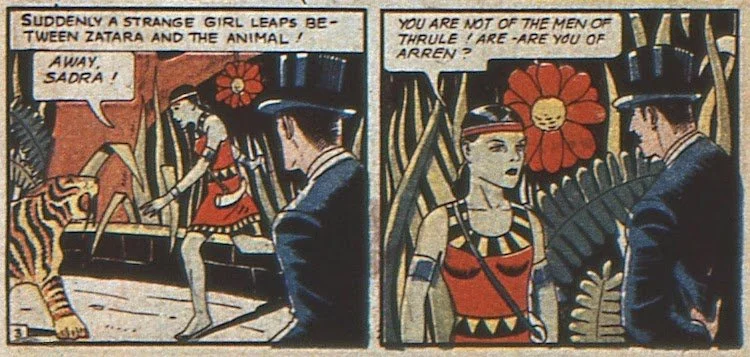
Duoro.
The first person Zatara meets in the fourth dimension is a maiden named Duoro, who, upon seeing Zatara’s magic, takes him to the king of Thrule, the tyrannical Xataral. Instead of bonding over how similar their names are, Xataral orders Zatara to steal the mystical “Necklace of Baya” from the warring nation of Arren. Zatara refuses until Duoro pleads with him, showing him men being actively disintegrated on the battlefield by Arren’s terrible weapons. It’s genuinely pretty gruesome despite the relatively simple art.
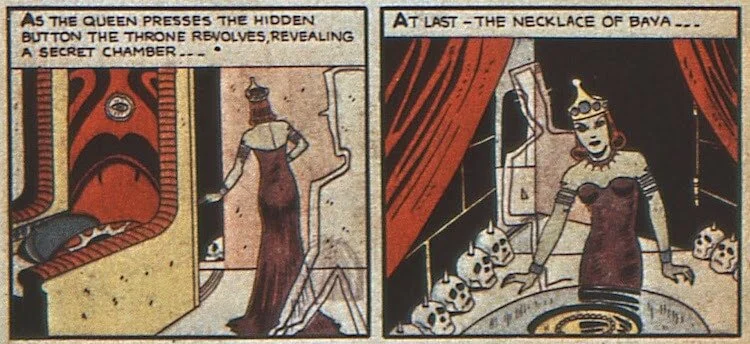
Mulano.
Horrified, Zatara agrees to end the war his way. He takes a flying horse to Arren (although at one point he also turns into a giant vulture wearing a top hat, which is probably the best part of the story), and orders Queen Mulano of Arren to end the war. She refuses, so he turns her into a hag. She agrees to end the war if he restores her youth and beauty. Sigh.
Zatara returns to Thrule with Queen Mulano, only to be informed by Duoro that Xataral has randomly died off-panel, leaving Thrule with no leader to sign the peace treaty. Zatara has an idea: what if Duoro and Mulano combined the nations and ruled them together? He even has a ship name—I mean, a new kingdom name for them: Duomal!
Duoro and Mulano agree and seal the treaty with a kiss. Having ended a war, Zatara returns to his own dimension to tell the professor about his adventures.
It would be stretching things to say that this comic from 1939 ends in a lesbian wedding. But…it doesn’t not end in a lesbian wedding, either.
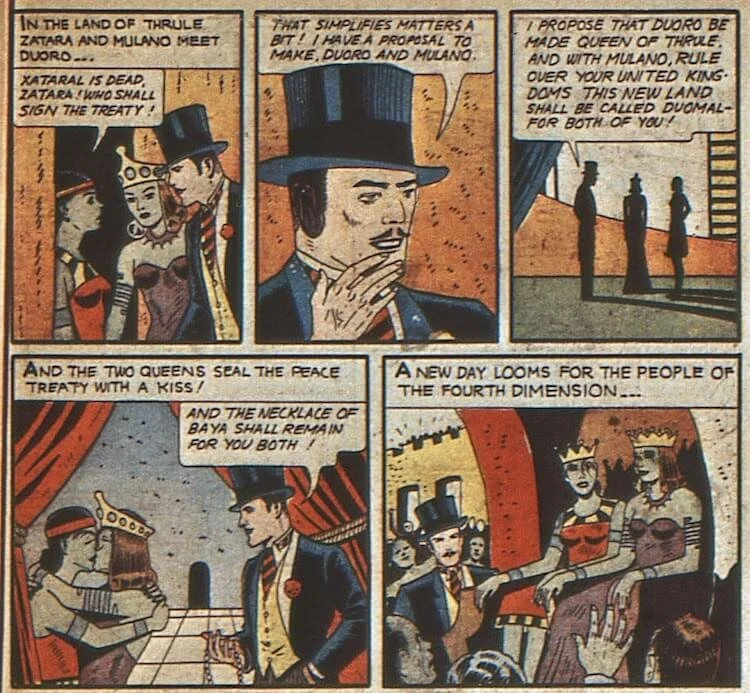
Give this man the Nobel Peace Prize.
The excellent resource GayLeague.com notes that both Fox and Guardineer were born in the early 1910s and would have seen the ratification of the 19th Amendment, giving women the vote, as well as the rise of the flapper and a general blurring of gender roles and presentations, with bobbed hair and increasing sexual liberation for women. I’m not entirely sure I buy this explanation for “In the Land of the Fourth Dimension,” a story that came out 19 years after the 19th Amendment, and nearly two decades after the flapper era. If anything, anxiety over gender roles in the 1930s was more likely to stem from the Great Depression and widespread unemployment among men who believed that they should be the breadwinners for their families, and that theme isn’t present at all in this story.
What is present in this story is racial stereotyping, and it’s possible that that plays a role in the conclusion. Fox and Guardineer wouldn’t be the first white men of this era (or any other) to be intrigued, amused, or alarmed by other cultures’ perceived failure to adhere to Western gender norms. In that light, the union of Duoro and Mulano could be viewed as mockery, although probably not condemnation—it does lead to a happy ending, after all. However, it’s impossible to say whether they were thinking about or even knew about the gender norms of any other culture when they created “In the Land of the Fourth Dimension.” Unless someone digs up an issue of Life magazine from 1938 with an article about, I don’t know, international courtship practices, and they can prove that Gardner Fox read it, I’m hesitant to assume that’s for sure what’s going on here.
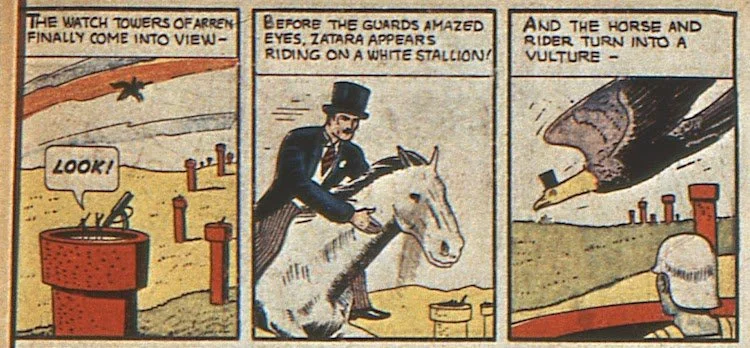
I would never deprive you of the image of a bird wearing a top hat. I don’t care if it’s relevant to queer history.
But speaking of historical context…it’s also worth noting that this issue hit stands in March of 1939. Historians date the start of World War II to Hitler’s invasion of Poland that September, but Germany’s war preparations and annexations were already well under way; the Spanish Civil War would also not end until that April. America was still largely isolationist and more than a little condescending about all these wars in Europe. The lead story in Action Comics #2 famously has Superman snatching up two opposing generals from made-up countries and telling them that if they want to fight, they’ll have to fight each other, no armies involved; the generals sheepishly admit that they don’t even know what they’re fighting about. An American (Zatara would later be confirmed to be an Italian immigrant, but not until decades after this) striding into an international conflict and telling those silly little foreigners to stop fighting was perfectly on trend.
Or maybe I’m overthinking this and two women merging their kingdoms was just meant to be another example of “Look how crazy things are in the topsy turvy land of the fourth dimension!” with zero cultural or political commentary intended.
Finally, it’s worth noting that Zatara does not, in fact, suggest that the queens get married, only that “Duoro be made queen of Thrule, and with Mulano, rule over [their] united kingdoms.” I like to imagine him standing there awkwardly like “Oh, you don’t have to kiss…oh, you’re still doing it. Okay, I’ll just…I’ll just wait.”
Duoro and Mulano have never appeared again, unsurprisingly, but never say never! I’d love to see a DC character visit Duomal again someday, although ideally with a bit more cultural sensitivity. A queer land, indeed.